AI-Powered Predictions in Financial Markets: A Complete Guide
S.C.G.A. Team
March 14, 2026
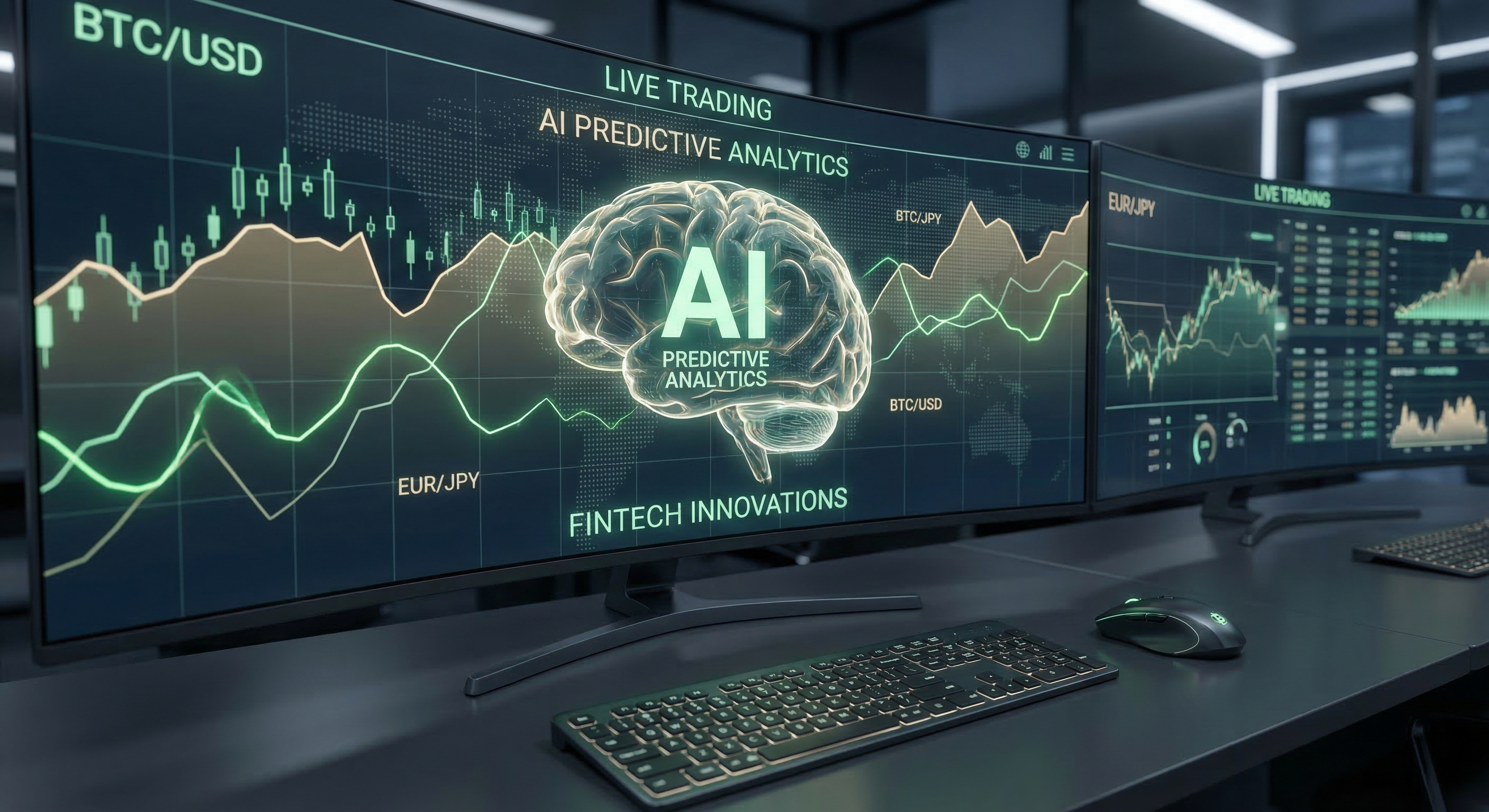
AI is transforming financial markets with advanced prediction algorithms and automated trading systems.
Artificial intelligence is transforming how we analyze markets, manage risks, and make investment decisions. The financial industry has embraced AI more rapidly than most sectors, recognizing its potential to process vast amounts of data and identify patterns invisible to human analysts.
From hedge funds to retail trading platforms, AI-powered systems are becoming ubiquitous in financial markets. These systems can analyze news, social media, economic indicators, and historical price data simultaneously, making decisions in milliseconds that would take humans hours or days.
The Role of AI in Financial Markets
Financial markets generate enormous amounts of data daily - from price movements and trading volumes to news articles and social media posts. AI can analyze this data millions of times faster than humans, identifying patterns and making predictions that drive better investment decisions.
The applications of AI in finance extend far beyond simple price prediction. Modern AI systems handle portfolio optimization, risk management, fraud detection, customer service, and compliance monitoring. This comprehensive applicability makes AI invaluable for financial institutions seeking competitive advantages.
Key Applications of AI in Finance
1. Price Prediction and Forecasting
AI models analyze historical prices, trading volumes, and market indicators to forecast asset prices. These models can identify complex non-linear patterns that traditional statistical methods miss.
Modern price prediction systems incorporate:
- Technical indicators and chart patterns
- Fundamental analysis data
- Sentiment analysis from news and social media
- Macroeconomic indicators
- Options and derivatives data
- Alternative data sources (satellite imagery, web traffic)
The most sophisticated systems use deep learning to automatically extract relevant features from raw data, eliminating the need for manual feature engineering.
2. Risk Assessment and Management
Machine learning evaluates credit and market risks with unprecedented accuracy. AI systems can process thousands of variables to assess borrower risk, predict loan defaults, and identify potential problem accounts before they become problematic.
Key risk applications include:
- Credit scoring using alternative data
- Real-time market risk monitoring
- Counterparty risk assessment
- Operational risk identification
- Regulatory compliance monitoring
- Stress testing and scenario analysis
3. Algorithmic Trading
AI-powered trading systems execute trades at optimal times based on predefined criteria and real-time market analysis. These systems can react to market conditions faster than any human trader.
Types of algorithmic trading include:
- Quantitative Trading: Mathematical models identify trading opportunities
- High-Frequency Trading: Ultra-fast execution for small profits
- Statistical Arbitrage: Exploiting pricing inefficiencies
- Mean Reversion: Trading based on price returning to average
- Trend Following: Riding momentum in various timeframes
- Pair Trading: Exploiting correlations between related assets
4. Portfolio Optimization
AI helps construct and rebalance portfolios that maximize returns for given risk levels. Modern portfolio theory is enhanced with machine learning to account for non-linear relationships and changing market dynamics.
5. Fraud Detection
Machine learning algorithms identify suspicious transactions in real-time, preventing fraud before losses occur. These systems learn from historical fraud patterns and adapt to new attack vectors.
6. Customer Service and Advisory
AI-powered chatbots and robo-advisors provide personalized financial advice at scale. These systems can handle routine inquiries, provide investment recommendations, and assist with account management.
Benefits of AI in Financial Markets
BenefitDescriptionTypical Impact SpeedProcess data millions of times faster than humansReal-time decision making AccuracyMore precise predictions and forecasts70-90% prediction accuracy in many applications ConsistencyUnbiased, emotion-free decisionsMore disciplined trading ScaleMonitor and analyze thousands of instrumentsBroader market coverage Cost ReductionAutomated processes reduce labor costs30-50% reduction in operational costs 24/7 OperationContinuous market monitoringNever miss opportunities
Challenges and Considerations
Data Quality and Availability
AI models are only as good as the data they’re trained on. Financial data often contains noise, missing values, and biases that can lead to poor predictions. Quality data acquisition and cleaning is crucial.
Model Risk
Overfitting is a significant concern in financial ML. Models that perform well on historical data may fail in live markets. Proper validation and backtesting are essential.
Market Efficiency
As more participants use AI, markets become more efficient, potentially reducing alpha generation. Successful AI strategies require continuous innovation.
Regulatory Compliance
Financial AI systems must comply with various regulations including market manipulation rules, algorithmic trading requirements, and consumer protection laws.
Black Swan Events
AI models struggle with unprecedented events like financial crises. Human oversight remains essential for risk management.
Market Manipulation Detection
AI systems identify potential market manipulation including spoofing, wash trading, and pump-and-dump schemes. Regulatory bodies increasingly rely on AI surveillance to maintain market integrity and protect investors from fraudulent activities.
Our Financial Prediction Solutions
At S.C.G.A., we develop custom AI-powered prediction systems for financial markets. Our expertise includes:
- Stock price prediction models
- Market trend analysis systems
- Risk assessment algorithms
- Automated trading systems
- Portfolio optimization tools
- Sentiment analysis for market prediction
Our team combines deep knowledge of financial markets with advanced machine learning expertise to deliver prediction systems that meet your specific requirements.
Future of AI in Finance
The future of AI in finance looks incredibly promising. Emerging trends include:
Natural Language Processing
Advanced NLP will enable AI to better understand and analyze financial news, earnings calls, and regulatory filings in real-time.
Reinforcement Learning
More sophisticated RL algorithms will enable AI systems to learn optimal trading strategies through market simulation.
Federated Learning
Privacy-preserving ML will enable collaboration between financial institutions without sharing sensitive data.
Explainable AI
As AI decisions face increasing scrutiny, explainable AI will become crucial for regulatory compliance and user trust.
The Technology Stack Behind Financial AI
Modern financial AI systems rely on sophisticated technology infrastructure that enables real-time data processing, complex model training, and low-latency inference. Understanding this technology stack helps financial institutions plan AI initiatives realistically.
High-frequency trading systems require infrastructure that operates at microsecond latency, while longer-term investment strategies can tolerate delays measured in hours or days. This diversity of requirements means financial AI often involves multiple specialized technology stacks optimized for different use cases.
Data Infrastructure
Financial AI requires robust data infrastructure capable of ingesting, processing, and storing massive data volumes. Market data arrives at extremely high frequencies, particularly in high-frequency trading contexts where latency is measured in microseconds. Time series databases optimized for financial data enable efficient storage and retrieval. Data lakes support diverse data types including traditional structured data alongside alternative data sources like satellite imagery and sentiment data.
Data quality management ensures AI models receive accurate, clean inputs. Financial data errors can have significant consequences, making data validation and cleansing essential. Automated pipelines that detect and correct data anomalies maintain model integrity over time.
Computing Infrastructure
Model training for complex financial AI requires substantial computational resources. GPU clusters accelerate deep learning training, while cloud platforms provide elastic scaling for variable workloads. Model inference often requires different infrastructure—low-latency environments optimized for rapid decision-making rather than batch processing.
Edge computing is increasingly relevant for financial AI, particularly for applications requiring real-time responses in distributed environments. Edge AI enables rapid local inference without round-trip latency to central servers.
Model Deployment and Monitoring
Deploying AI models to production financial environments requires careful attention to reliability and performance. Model serving platforms must handle high throughput while maintaining low latency. A/B testing frameworks enable controlled model updates with rollback capabilities. Continuous monitoring detects model degradation, data drift, and performance anomalies before they impact trading outcomes.
Responsible AI in Financial Markets
AI deployment in financial markets raises important ethical considerations that responsible institutions must address. Fairness, transparency, and accountability are essential principles that guide responsible AI adoption.
Fairness and Bias
AI models can inadvertently perpetuate or amplify biases present in historical data. Credit scoring models trained on historical lending data may reflect past discriminatory practices. Regular fairness audits identify potential bias in model predictions, while diverse training data and algorithmic fairness techniques help mitigate discriminatory outcomes.
Transparency and Explainability
Financial regulators increasingly require explainability of AI-driven decisions. When AI systems approve or deny loans, detect fraud, or generate trading signals, stakeholders need to understand the reasoning behind these decisions. Explainable AI techniques provide insights into model predictions without sacrificing predictive performance.
Risk Management for AI Systems
AI systems introduce new risk categories that traditional risk management frameworks may not adequately address. Model risk—the risk that models produce incorrect or misused outputs—requires dedicated management processes. Stress testing AI systems against extreme market conditions, establishing human oversight for consequential decisions, and maintaining robust model governance all contribute to responsible AI deployment.
Building AI-Powered Financial Systems
Implementing AI in financial organizations requires careful planning and execution. Success depends not just on technology but on organizational readiness, data infrastructure, and strategic alignment.
Data Infrastructure Requirements
AI systems require robust data infrastructure capable of supporting real-time processing and analysis. Financial institutions must invest in data quality management, ensuring that AI models receive accurate, clean inputs. Time series databases optimized for financial data enable efficient storage and retrieval of market information.
Market data arrives at extremely high frequencies, particularly in high-frequency trading contexts. Latency requirements are measured in microseconds, demanding specialized infrastructure. Data lakes support diverse data types including alternative data sources like satellite imagery and sentiment data.
Talent and Organization
Building AI capabilities requires both technical talent and organizational culture that supports data-driven decision-making. Successful institutions combine data scientists with domain experts who understand financial markets deeply. Cultural elements include experimentation comfort, failure learning, and continuous improvement mindsets.
Model Risk Management
Financial AI requires robust model risk management frameworks. This includes model validation, performance monitoring, and governance processes. Models must be regularly tested against new data and updated as market conditions evolve. Human oversight remains essential for consequential decisions.
The Future of AI in Financial Markets
The trajectory of AI in finance points toward increasingly sophisticated capabilities. Large language models will enable AI to better understand and analyze financial documents, regulatory filings, and news in real-time. Reinforcement learning will enable AI systems that learn optimal trading strategies through market simulation.
Privacy-Preserving AI
Federated learning and other privacy-preserving techniques will enable collaboration between financial institutions without sharing sensitive data. This approach enables institutions to benefit from collective intelligence while preserving data privacy.
Autonomous Finance
The future may see increasingly autonomous financial systems where AI handles routine decisions while humans focus on strategic direction. This shift requires careful consideration of governance, accountability, and the role of human judgment in financial decision-making.
Conclusion
AI is revolutionizing financial markets, providing tools that make prediction more accurate, risk management more effective, and trading more efficient. While challenges exist, the benefits of AI in finance are substantial and growing.
At S.C.G.A., we’re committed to helping financial institutions leverage AI effectively. Contact us today to learn how our AI-powered solutions can enhance your investment decisions and trading operations.