Why Your Business Needs an AI Prediction System: A Comprehensive Guide
S.C.G.A. Team
March 14, 2026
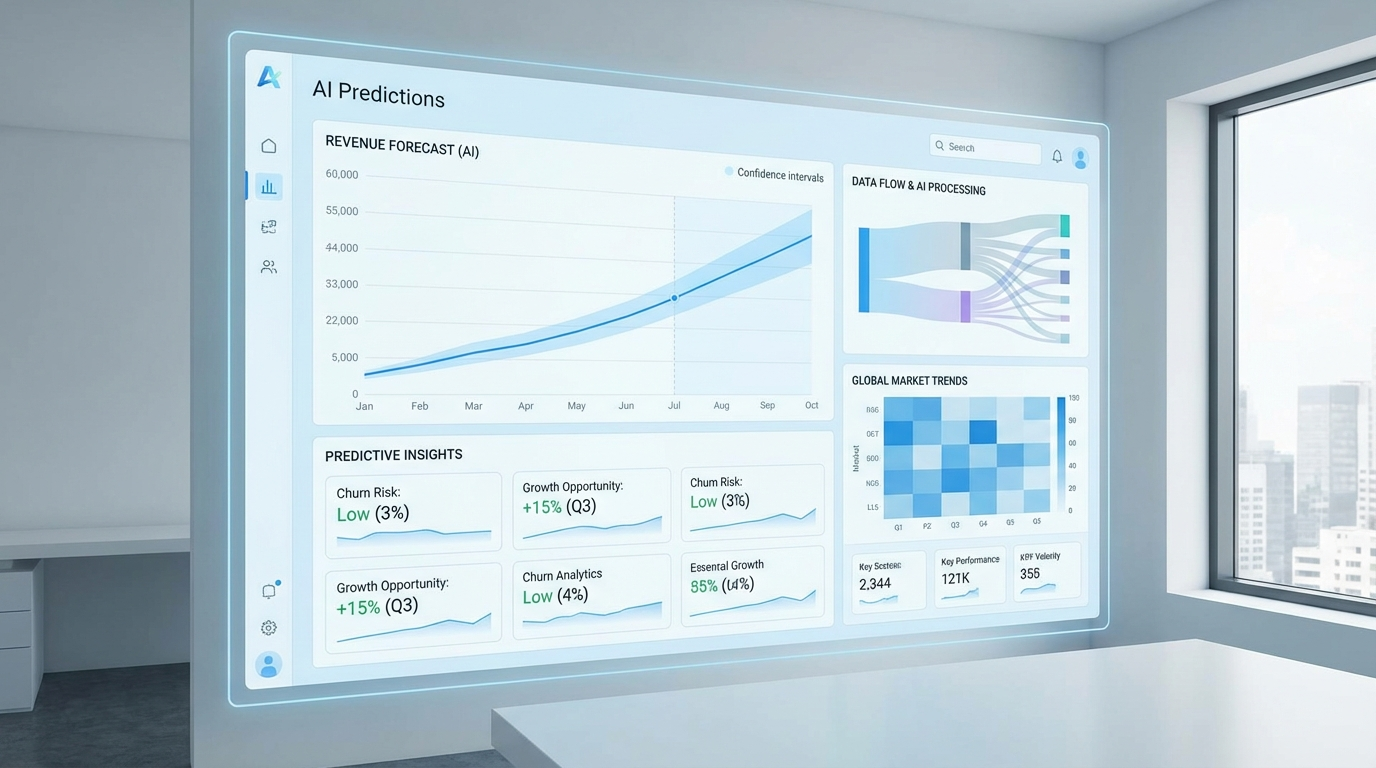
In todays fast-paced business environment, AI prediction systems provide competitive advantage.
In today’s fast-paced business environment, making decisions based on gut feelings and intuition is no longer sustainable. Companies that leverage AI prediction systems are gaining a significant competitive advantage over those that rely on traditional methods. According to McKinsey, companies using AI for predictions see significant improvements in decision-making accuracy, often exceeding 30% improvement in forecast accuracy.
The volume of data generated by modern businesses is staggering. Every transaction, customer interaction, and operational process creates data that, when properly analyzed, can reveal patterns and predict future outcomes. AI prediction systems harness this data to provide insights that were previously impossible to obtain.
What is an AI Prediction System?
An AI prediction system uses machine learning algorithms to analyze historical data and predict future outcomes. Unlike traditional statistical methods, AI systems can handle complex, non-linear relationships in data and automatically improve over time as they learn from new information.
Modern prediction systems combine multiple techniques including deep learning, ensemble methods, and transfer learning to achieve unprecedented accuracy. They can process multiple data sources simultaneously, identifying patterns that would be impossible for humans to detect.
Key Benefits for Your Business
BenefitDescriptionBusiness Impact Data-Driven DecisionsMake decisions based on hard data, not assumptions30%+ improvement in accuracy Cost ReductionPredict maintenance needs before equipment fails40% reduction in downtime Customer BehaviorForecast customer churn and preferences25% improvement in retention Sales ForecastingPredict demand with higher accuracy20-50% reduction in waste Risk ManagementIdentify and mitigate risks earlySignificant loss prevention Resource OptimizationAllocate resources more efficiently15-30% cost savings
Types of Predictions AI Can Make
Sales and Demand Forecasting
Predict future sales volumes, seasonal demand patterns, and inventory needs. This enables optimal stock levels, reducing both stockouts and excess inventory.
Customer Behavior Prediction
Forecast which customers are likely to churn, which are most likely to convert, and what products they might be interested in. This enables targeted marketing and improved customer retention.
Financial Predictions
Predict cash flow, revenue, market trends, and investment outcomes. This enables better financial planning and risk management.
Operational Predictions
Predict equipment failures, maintenance needs, and supply chain disruptions. This enables proactive maintenance and operational continuity.
Risk Assessment
Evaluate credit risk, insurance claims, and fraud probability. This enables better underwriting and fraud prevention.
Market Trends
Analyze market conditions, competitor behavior, and emerging trends. This enables strategic planning and competitive positioning.
Industries We Serve
Our AI prediction systems have been deployed across multiple industries:
Finance
- Stock market predictions and trading signals
- Credit risk assessment and loan approval
- Portfolio optimization and rebalancing
- Fraud detection and prevention
- Market trend analysis
Sports Analytics
- Horse racing predictions
- Sports betting algorithms
- Player performance forecasting
- Game outcome predictions
Retail
- Inventory management and demand forecasting
- Customer segmentation and targeting
- Price optimization
- Loss prevention
Healthcare
- Patient outcome predictions
- Disease progression modeling
- Resource allocation optimization
- Readmission risk assessment
Manufacturing
- Predictive maintenance
- Quality control and defect prediction
- Supply chain optimization
- Production planning
Real Estate
- Property value estimation
- Market trend analysis
- Investment opportunity identification
- Rental yield prediction
Why Choose S.C.G.A. Limited?
At S.C.G.A. Limited, we specialize in building custom AI prediction systems tailored to your specific business needs. Here’s why businesses trust us:
Expert Team
Our team combines deep expertise in machine learning, data science, and domain-specific knowledge. We understand both the technical aspects and the business context.
Custom Solutions
We don’t offer generic solutions. Every system we build is designed specifically for your data, your processes, and your goals.
Proven Results
Our prediction systems have delivered measurable results for clients across various industries. We measure success by your business outcomes.
End-to-End Support
From initial consultation to ongoing maintenance, we provide comprehensive support at every stage of your AI journey.
Our Approach
We follow a structured methodology to ensure successful prediction system deployment:
1. Consultation
We start by understanding your business challenges, objectives, and constraints. This ensures we build a solution that addresses your real needs.
2. Data Analysis
We assess your data sources, quality, and availability. This helps us understand what predictions are possible and what data improvements might be needed.
3. Model Development
We build custom ML models using the most appropriate algorithms and techniques for your specific use case. We test multiple approaches to find the best solution.
4. Validation
We thoroughly validate predictions using historical data and real-world testing. We ensure the system meets your accuracy requirements.
5. Deployment
We integrate the prediction system into your existing systems and workflows. We ensure seamless operation with minimal disruption.
6. Ongoing Support
We provide continuous monitoring and maintenance to ensure predictions remain accurate as conditions change. We make improvements based on new data and feedback.
Technology Stack
We use the latest AI and machine learning technologies:
- TensorFlow: Deep learning and neural networks
- PyTorch: Flexible ML development
- scikit-learn: Traditional ML algorithms
- XGBoost: Gradient boosting for structured data
- Prophet: Time series forecasting
- AWS SageMaker: Cloud-based ML deployment
- Custom APIs: Seamless integration
Getting Started
Ready to transform your business with AI predictions? Here’s how to begin:
- Identify Key Decisions: List the predictions that would most impact your business
- Assess Your Data: Understand what data you have available
- Start Small: Begin with a pilot project to demonstrate value
- Scale Up: Expand to additional use cases as you see results
Understanding Prediction Model Types
Different prediction tasks require different modeling approaches. Understanding the available model types helps businesses choose the right solution for their specific needs.
Regression Models
Regression models predict continuous numerical values. They answer questions like “how much?” or “how many?” Common applications include sales forecasting, price prediction, and demand estimation. Linear regression provides interpretable baseline models, while more sophisticated approaches like gradient boosting offer higher accuracy for complex relationships.
Classification Models
Classification models predict categorical outcomes—which category does this item belong to? Applications include fraud detection (fraudulent or legitimate), customer classification (high-value or low-value), and risk categorization (low, medium, or high risk). Modern classification algorithms achieve remarkable accuracy when trained on sufficient data.
Time Series Models
Time series models specialize in data where temporal ordering matters. They capture seasonality, trends, and cyclical patterns that traditional models miss. Applications include financial forecasting, demand planning, and resource allocation. Advanced time series approaches combine statistical methods with machine learning for superior accuracy.
Anomaly Detection Models
Anomaly detection identifies unusual patterns that deviate from expected behavior. These models are unsupervised—they learn what “normal” looks like and flag deviations. Applications include fraud detection, equipment monitoring, and quality control.
Data Requirements for Effective Predictions
The quality and quantity of your data directly determines prediction accuracy. Understanding data requirements helps set realistic expectations and identify data improvement priorities.
Historical Data
Most prediction systems require substantial historical data for training. The required volume depends on prediction complexity—simple predictions may need thousands of records, while complex predictions may need millions. Historical data must cover representative scenarios including both normal and edge cases.
Feature Quality
Features are the input variables your model uses for predictions. High-quality features are predictive of the outcome, accurately measured, and available consistently. Feature engineering—creating meaningful derived variables from raw data—is often the difference between mediocre and excellent predictions.
Data Freshness
Predictions degrade as data becomes stale. Establish processes for regular data updates and model retraining. The appropriate update frequency depends on your domain—financial predictions may need daily updates, while some operational predictions may be stable over weeks.
Building a Prediction-Ready Organization
Successful prediction systems require organizational readiness beyond technical capabilities. Building a prediction-ready organization means developing processes, culture, and skills that support data-driven decision-making.
Leadership Commitment
Prediction initiatives require leadership commitment to succeed. Leaders must prioritize data-driven decision-making, allocate resources for prediction capabilities, and model the use of predictions in their own decisions. Without leadership support, prediction efforts remain isolated experiments rather than organizational capabilities.
Cross-Functional Collaboration
Effective predictions require collaboration between data scientists, domain experts, and business stakeholders. Data scientists bring technical expertise, domain experts provide contextual knowledge, and business stakeholders ensure predictions address genuine business needs. Building effective collaboration takes intentional effort and ongoing investment.
Skills Development
Building organizational prediction capabilities requires developing internal skills. Start with training programs that build data literacy across the organization. Identify employees with aptitude for analytical work and invest in their development. Over time, these investments build an organization that can independently develop and maintain prediction systems.
AI Prediction System Implementation: A Practical Guide
Implementing an AI prediction system is a significant undertaking that requires careful planning, execution, and ongoing refinement. Organizations that approach prediction system implementation strategically achieve significantly better results than those that deploy technology without adequate preparation.
Starting with Business Problem Definition
Before selecting any technology, ensure you have a clear definition of the business problem you want the prediction system to solve. The most successful prediction implementations begin with well-defined success criteria: what outcome do you want to predict, how accurate must predictions be to deliver value, and what business decisions will predictions inform? Vague objectives lead to unfocused solutions that deliver mediocre results.
Data Assessment and Preparation
Data is the foundation of any prediction system. Assess your existing data sources, identify gaps, and establish data quality processes before beginning model development. Data preparation typically consumes 60-80% of total project effort—underestimating this leads to project delays and disappointing results. Invest in data infrastructure that will support ongoing prediction needs, not just immediate requirements.
Building a Proof of Concept
Before committing to full-scale implementation, build a proof of concept with limited scope. A successful POC validates the technical approach, demonstrates prediction value, and builds organizational confidence. Use the POC to refine requirements, identify technical challenges, and develop team expertise before scaling up.
Selecting the Right Approach
Not every prediction problem requires cutting-edge deep learning. Start with simpler approaches—logistic regression, decision trees, or gradient boosting often deliver adequate performance with greater interpretability and simpler deployment. Reserve complex approaches for problems where simpler methods prove insufficient.
Deployment and Integration Planning
Predictions only create value when integrated into business workflows. Plan for integration from the start: identify who will use predictions, how predictions will be delivered, and what systems must receive prediction outputs. Poor integration is the most common reason prediction projects fail to deliver business value despite strong technical performance.
Emerging Trends in AI Prediction Technology
The field of AI prediction continues to evolve rapidly, with new capabilities and approaches emerging regularly. Understanding these trends helps organizations make informed decisions about prediction technology investments and positioning.
Foundation Models for Prediction
Foundation models—large pre-trained models that can be fine-tuned for specific tasks—are beginning to transform prediction technology. Rather than training prediction models from scratch, organizations can fine-tune pre-trained models with their own data, achieving strong performance with significantly less training data and computational resources. This democratization of prediction technology enables smaller organizations to leverage sophisticated prediction capabilities previously available only to large enterprises with substantial data science resources.
Real-Time Predictive Systems
Traditional prediction systems often operated in batch processing modes, generating predictions on scheduled intervals. The emerging trend is toward real-time prediction—continuous updating of predictions as new data arrives. Real-time prediction enables faster response to changing conditions, whether monitoring equipment in manufacturing, detecting fraud in financial transactions, or adjusting demand forecasts in response to promotional campaigns.
Causal Inference in Prediction
Traditional machine learning prediction identifies correlations in historical data but struggles to distinguish correlation from causation. Causal inference techniques enable prediction systems to estimate the impact of interventions—how would outcomes change if we took a specific action? This capability moves prediction from “what will happen” to “what should we do,” directly informing decision-making rather than just forecasting.
Automated Machine Learning
AutoML platforms automate much of the model development process, including feature engineering, algorithm selection, and hyperparameter tuning. These platforms make prediction technology accessible to organizations without large data science teams, enabling rapid prototyping and development of prediction capabilities. While AutoML cannot replace expert data scientists for complex problems, it dramatically accelerates development for common prediction scenarios.
Advanced Applications of AI Prediction
As prediction technology matures, organizations are discovering increasingly sophisticated applications that create significant business value beyond traditional forecasting scenarios.
Prescriptive Analytics: From Prediction to Action
The most advanced organizations move beyond predictive analytics to prescriptive analytics—using predictions not just to forecast outcomes but to recommend specific actions. Prescriptive systems combine prediction with optimization algorithms to identify the best course of action given predicted outcomes and business constraints. This capability transforms prediction from a forecasting tool into a decision-making system.
Consider a retailer using prescriptive analytics for inventory management. Rather than simply predicting demand and manually determining order quantities, a prescriptive system predicts demand, simulates the impact of different ordering decisions on inventory costs and service levels, and recommends optimal order quantities that balance competing objectives. The system essentially automates decision-making that previously required human judgment.
Generative AI for Prediction Enhancement
Generative AI is beginning to enhance prediction systems in unexpected ways. Synthetic data generation can augment limited training data, improving prediction accuracy for rare events. Language models can generate natural language explanations of predictions, making complex model outputs accessible to non-technical stakeholders. Multimodal AI can incorporate diverse data types—images, text, time series—into unified prediction frameworks.
Federated Prediction Systems
Privacy concerns and data sovereignty requirements are driving interest in federated prediction approaches. Rather than centralizing data for model training, federated learning trains prediction models across distributed datasets without exchanging raw data. This approach enables collaboration on prediction improvement while preserving data privacy—valuable for industries like healthcare where patient data cannot be easily shared across organizations.
Conclusion
In today’s competitive business environment, AI prediction systems are no longer a luxury—they’re a necessity. Businesses that embrace AI predictions gain significant advantages in accuracy, efficiency, and decision-making.
At S.C.G.A. Limited, we’re committed to helping businesses harness the power of AI predictions. Contact us for a free consultation and discover how AI can transform your business.