Cloud Solutions: AWS vs Google Cloud Platform - A Comprehensive Comparison for Your Business
S.C.G.A. Team
March 16, 2026
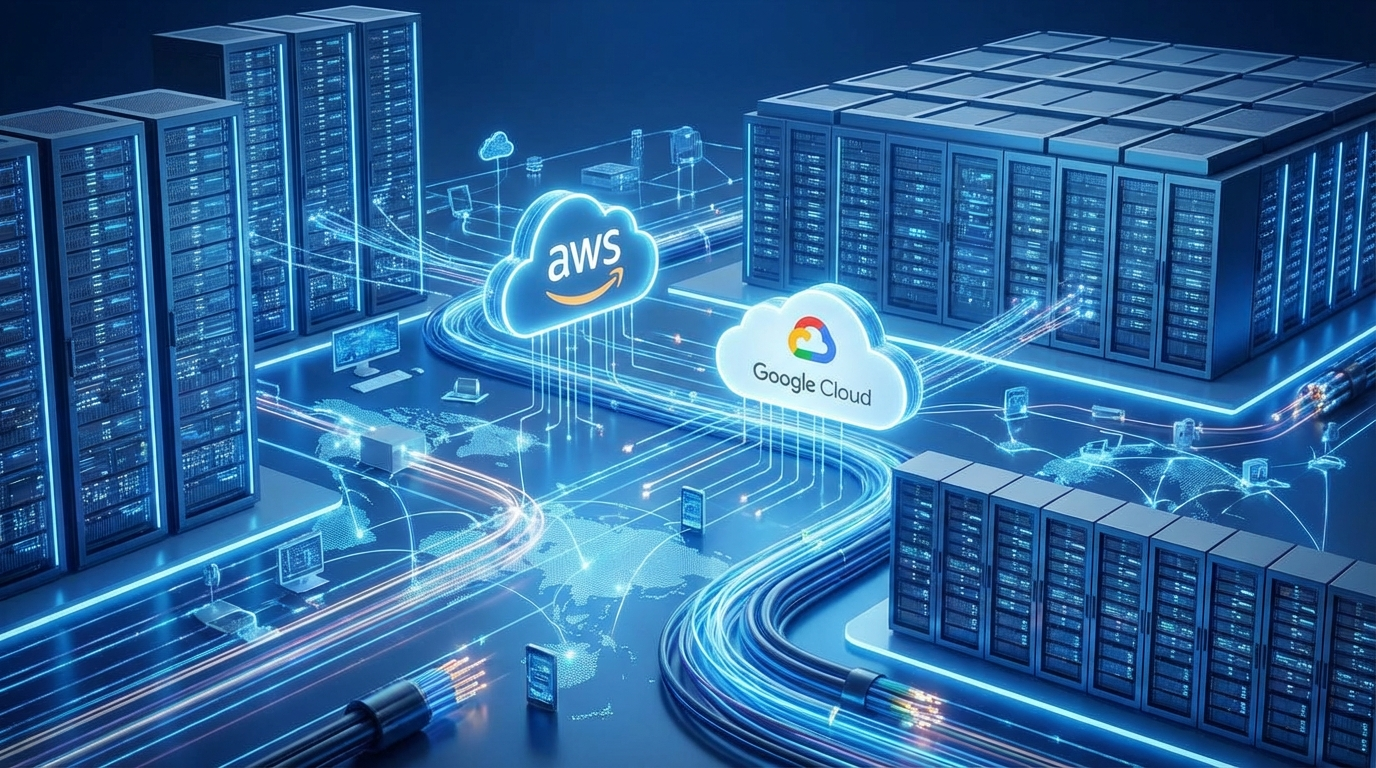
Compare AWS and GCP for your business needs.
Cloud computing has become essential for modern businesses, offering scalability, cost-efficiency, and enterprise-grade infrastructure. Two major players dominate the market: Amazon Web Services (AWS) and Google Cloud Platform (GCP). This comprehensive guide helps you choose the right cloud solution for your business.
Why Cloud Computing is Essential
The shift to cloud computing represents one of the most significant technological transformations in business history. Organizations worldwide are migrating their infrastructure, applications, and services to the cloud to gain competitive advantages that were previously unavailable.
Cloud computing eliminates the need for massive upfront capital investments in hardware, reduces operational complexity, and provides the flexibility to scale resources based on demand.
Key Benefits of Cloud Solutions
- Scalability: Scale up or down instantly based on your business needs without hardware limitations.
- Cost Savings: Pay only for what you use with no upfront infrastructure investments.
- Reliability: Enterprise-grade infrastructure with 99.99% uptime guarantees and global presence.
- Security: Advanced security features including encryption, identity management, and compliance certifications.
- Innovation: Access to cutting-edge services like AI/ML, analytics, and serverless computing.
- Global Reach: Deploy applications worldwide with data centers in multiple regions.
Amazon Web Services (AWS) - The Market Leader
AWS is the pioneer and market leader in cloud computing, offering the most comprehensive and widely adopted cloud platform globally. With over 200 services, AWS provides solutions for virtually every business need.
AWS Strengths
- Most Comprehensive Service Offering: AWS offers the broadest range of services.
- Largest Market Share: As the first cloud provider, AWS maintains the largest market share.
- Extensive Partner Ecosystem: Thousands of partners offer consulting, implementation, and support services.
- Mature Enterprise Tools: Well-established tools for governance, security, and compliance.
Google Cloud Platform (GCP) - The Innovation Leader
Google Cloud Platform, powered by Google’s infrastructure, excels in data analytics, machine learning, and containerized workloads. GCP is particularly attractive for organizations prioritizing these capabilities.
GCP Strengths
- Best-in-Class AI/ML Capabilities: Google leads in artificial intelligence and machine learning.
- Strong Data Analytics: BigQuery provides enterprise-grade data warehousing with exceptional performance.
- Competitive Pricing: Often more cost-effective, especially for data analytics and compute workloads.
- Container Excellence: Kubernetes originated at Google, and GCP offers the best container orchestration.
When to Choose AWS
AWS is ideal for organizations that need:
- The widest range of cloud services
- Enterprise-grade solutions with proven track record
- Extensive partner and consulting support
- Mature DevOps and CI/CD tools
When to Choose GCP
GCP is ideal for organizations that prioritize:
- Data analytics and big data processing
- Machine learning and AI capabilities
- Containerized workloads with Kubernetes
- Cost-effectiveness for specific workloads
Cloud Migration Strategies
Migrating to the cloud requires careful planning and execution. A successful migration minimizes disruption while maximizing cloud benefits. Understanding different migration approaches helps organizations choose the right strategy for their situation.
Lift and Shift Migration
The lift-and-shift approach moves existing applications to cloud infrastructure with minimal modification. This strategy offers quick migration timelines and straightforward execution, making it attractive for organizations under time pressure. However, this approach may not fully leverage cloud-native capabilities or achieve optimal cost efficiency.
Replatforming
Replatforming involves making targeted modifications to take advantage of cloud capabilities without complete re-architecture. Common replatforming activities include switching to managed database services, implementing auto-scaling, and adding CDN distribution. This approach balances cloud optimization with migration simplicity.
Refactoring and Re-architecture
Refactoring involves redesigning applications to fully leverage cloud-native patterns. This approach enables maximum cloud benefits—elastic scalability, serverless computing, microservices—but requires significant development effort. Refactoring is appropriate for strategic applications where cloud-native capabilities provide substantial business value.
Cloud Cost Management
Cloud costs can quickly exceed expectations without proper management. Understanding and optimizing cloud spending is essential for realizing cloud benefits.
Cost Monitoring and Allocation
Implement comprehensive cost monitoring that provides visibility into spending by service, team, and project. Cloud provider tools like AWS Cost Explorer and GCP Billing provide detailed cost analytics. Third-party tools offer additional capabilities for cost allocation, anomaly detection, and optimization recommendations.
Reserved Capacity vs On-Demand
Cloud pricing models offer tradeoffs between commitment and flexibility. Reserved instances offer significant discounts (often 30-60%) in exchange for upfront commitment. Savings plans provide similar discounts with more flexibility. On-demand pricing offers maximum flexibility at premium rates. Balancing these options based on predictable baseline workloads optimizes costs.
Rightsizing Resources
Overprovisioned resources waste money while underprovisioned resources compromise performance. Regular rightsizing reviews compare provisioned capacity against actual utilization, identifying opportunities to downsize underutilized resources. Automated rightsizing tools continuously optimize based on utilization patterns.
Cloud Security Best Practices
Security remains the top concern for cloud adoption. Following security best practices ensures cloud deployments are properly protected.
Identity and Access Management
Strong identity management is the foundation of cloud security. Implement least-privilege access, requiring users and services to have only the permissions they need. Use multi-factor authentication for all human access, enforce strong password policies, and rotate credentials regularly. Cloud IAM services provide fine-grained access control across all cloud resources.
Network Security
Cloud networks should be segmented and protected through security groups, network ACLs, and firewall rules. Private networking through VPCs or Virtual Networks isolates sensitive workloads. VPN and Private Connect services enable secure hybrid connectivity without exposing traffic to the public internet.
Data Encryption
Encrypt data at rest and in transit using cloud provider encryption services. Most providers offer transparent encryption with minimal performance overhead. Key management services provide control over encryption keys, enabling compliance with data residency requirements and supporting key rotation policies.
Cloud Migration Case Studies
Examining real-world cloud migration experiences provides practical insights for organizations undertaking their own migration journeys. These case studies illustrate common patterns, challenges, and success factors.
Enterprise Cloud Migration Patterns
Large enterprise migrations typically follow patterns established through accumulated experience across many organizations. Phased migration approaches reduce risk by limiting initial scope, while big-bang migrations accelerate timelines at the cost of higher risk. Hybrid approaches maintain some workloads on-premises while migrating others to cloud, often serving as intermediate steps toward full cloud adoption.
Common Migration Challenges
Application compatibility issues arise when legacy applications assume on-premises infrastructure characteristics that cloud environments don’t provide. Data migration complexity increases with data volume, requiring careful planning to manage transfer times and ensure data integrity. Security and compliance requirements must be addressed throughout migration, often requiring additional controls beyond those needed for on-premises operations.
Multi-Cloud Strategies
Many organizations adopt multi-cloud strategies that combine services from multiple providers. This approach offers resilience, avoids vendor lock-in, and enables leveraging the best capabilities from each provider. However, multi-cloud also introduces complexity that requires careful management.
Benefits of Multi-Cloud Architecture
Multi-cloud architectures provide resilience against provider outages—workloads can fail over to alternative providers when one provider experiences issues. This approach also provides negotiating leverage with cloud vendors, as organizations are not dependent on a single provider for critical services. Multi-cloud also enables innovation by allowing teams to use the most appropriate platform for specific workloads.
Challenges and Complexity
Managing multiple cloud platforms increases operational complexity. Each provider has different APIs, tools, and management interfaces. Cross-cloud networking introduces latency and cost considerations. Security and compliance management must address platform-specific requirements. Organizations must weigh these challenges against the benefits multi-cloud provides.
Cloud Management Platforms
Cloud management platforms provide unified interfaces for managing multi-cloud environments. Tools like Terraform, Pulumi, and vendor-specific management consoles help address complexity. Investment in management tooling typically pays dividends through reduced operational burden and improved governance.
Cloud-Native Development
Cloud-native development patterns leverage cloud platform capabilities to build more scalable, resilient, and manageable applications. These patterns represent a fundamental shift from traditional application development.
Microservices Architecture
Microservices architecture decomposes applications into small, independently deployable services. This approach enables teams to develop, deploy, and scale services independently, accelerating development velocity while improving fault isolation. However, microservices introduce complexity in service coordination and distributed system management.
Container Orchestration
Containers provide consistent application packaging across development and production environments. Kubernetes has emerged as the dominant container orchestration platform, providing automated deployment, scaling, and management of containerized applications. Managed Kubernetes services from cloud providers reduce the operational burden of running Kubernetes clusters.
Service Mesh
Service mesh technology provides infrastructure layer for microservice communication, handling traffic management, security, and observability without requiring application code changes. Istio and Linkerd provide comprehensive service mesh implementations that improve microservice operational characteristics.
Cloud Migration Case Studies
Examining real-world cloud migration experiences provides practical insights for organizations undertaking their own migration journeys. These case studies illustrate common patterns, challenges, and success factors.
Enterprise Cloud Migration Patterns
Large enterprise migrations typically follow patterns established through accumulated experience across many organizations. Phased migration approaches reduce risk by limiting initial scope, while big-bang migrations accelerate timelines at the cost of higher risk. Hybrid approaches maintain some workloads on-premises while migrating others to cloud, often serving as intermediate steps toward full cloud adoption.
Common Migration Challenges
Application compatibility issues arise when legacy applications assume on-premises infrastructure characteristics that cloud environments don’t provide. Data migration complexity increases with data volume, requiring careful planning to manage transfer times and ensure data integrity. Security and compliance requirements must be addressed throughout migration, often requiring additional controls beyond those needed for on-premises operations.
Migration Success Factors
Successful migrations share common characteristics: executive sponsorship ensures adequate resources and organizational alignment. Careful planning prevents surprises that derail timelines and budgets. Incremental approaches reduce risk by validating assumptions before committing fully. Strong governance maintains alignment between technical decisions and business objectives throughout the migration.
Cloud Cost Optimization Strategies
Cloud costs can escalate rapidly without proper management. Effective cost optimization requires ongoing attention to resource utilization and pricing model selection.
Reserved Capacity Planning
Reserved instances and savings plans provide significant discounts in exchange for usage commitments. Analyzing historical usage patterns reveals opportunities for reserved capacity purchases. Organizations with predictable baseline workloads can reduce costs by 30-60% through reserved capacity.
Spot Instance Strategies
Spot instances offer dramatic discounts for fault-tolerant workloads. Batch processing, machine learning training, and stateless web applications are well-suited for spot instance execution. Building application architecture that handles spot interruptions gracefully enables substantial savings.
Cost Allocation and Chargeback
Distributed cloud costs require allocation mechanisms that attribute spending to business units. Tagging strategies enable granular cost attribution. Chargeback models ensure business units have appropriate visibility into their cloud spending.
Conclusion
Both AWS and GCP offer excellent cloud solutions with distinct strengths. AWS provides the most comprehensive platform with proven enterprise capabilities, while GCP excels in data analytics, ML, and cost-effectiveness. The right choice depends on your specific requirements.
At S.C.G.A., we help businesses navigate their cloud journey. Contact us today to discuss your cloud strategy.