Computer Vision in Business: A Complete Guide for Modern Enterprises
S.C.G.A. Team
March 18, 2026
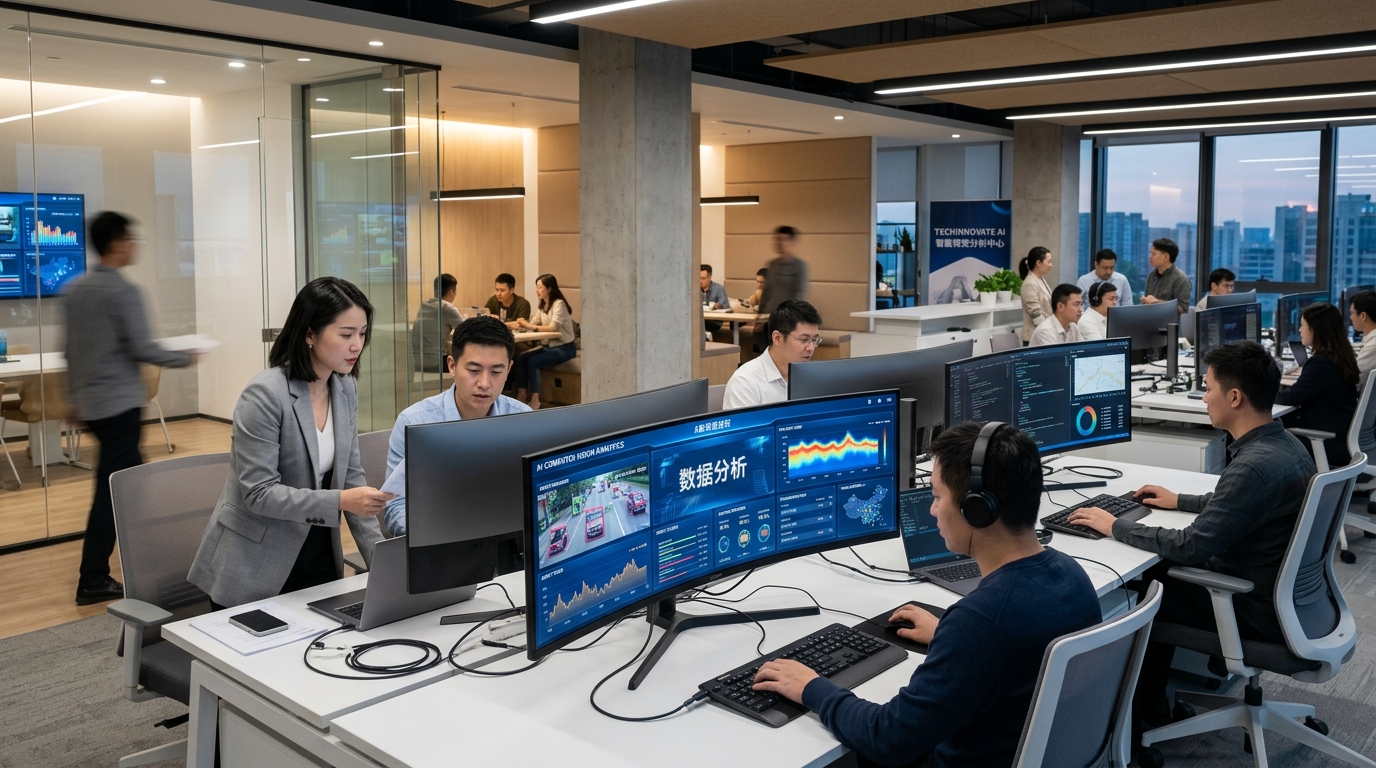
Computer vision is revolutionizing business operations across industries, enabling automated visual analysis, quality control, and customer experience improvements.
In the age of digital transformation, computer vision has emerged as one of the most powerful AI technologies for businesses. From automated quality control in manufacturing to customer behavior analysis in retail, computer vision is revolutionizing how companies operate, make decisions, and deliver value.
What is Computer Vision?
Computer vision is a field of artificial intelligence that enables machines to interpret and understand visual information from the world, much like human vision. Through deep learning algorithms and neural networks, computer vision systems can identify, classify, and react to objects, people, text, and scenes in images and videos.
Modern computer vision systems can perform remarkable tasks: identifying defects in products on assembly lines, detecting faces for security systems, analyzing customer movements in stores, reading text on documents, and even diagnosing medical conditions from X-rays and MRIs.
Key Technologies Powering Computer Vision
1. Convolutional Neural Networks (CNNs)
Convolutional Neural Networks form the backbone of most modern computer vision applications. These deep learning architectures are specifically designed to process pixel data, automatically learning hierarchical features from raw images.
2. Object Detection and Recognition
Object detection goes beyond simple image classification to locate and identify multiple objects within an image. Technologies like YOLO, Faster R-CNN, and SSD enable real-time object detection.
3. Facial Recognition Technology
Facial recognition has become one of the most widely deployed computer vision applications. Modern facial recognition achieves accuracy rates exceeding 99.9% under optimal conditions.
4. Image Segmentation
Image segmentation divides an image into meaningful regions, enabling pixel-level understanding. Instance segmentation distinguishes individual objects within the same category.
5. Optical Character Recognition (OCR)
OCR technology converts images of text into machine-readable text. Modern OCR systems can read handwritten notes, printed documents, and text in natural scenes with high accuracy.
Business Applications of Computer Vision
1. Retail and Customer Analytics
Computer vision is transforming retail operations by providing deep insights into customer behavior. Heat mapping technology tracks customer movements through stores, identifying high-traffic areas and optimizing store layouts.
2. Manufacturing and Quality Control
In manufacturing, computer vision has become essential for quality control and automation. Vision systems inspect products for defects at speeds impossible for human inspectors, typically achieving 99.9% or higher accuracy rates.
3. Healthcare and Medical Imaging
Computer vision is revolutionizing healthcare through advanced medical imaging analysis. AI systems can analyze X-rays, CT scans, MRIs, and pathology images to assist radiologists in detecting diseases.
4. Security and Surveillance
Modern surveillance systems leverage computer vision for intelligent security. Beyond simple motion detection, AI-powered systems can recognize faces, identify suspicious behaviors, and track individuals across camera networks.
5. Logistics and Supply Chain
Computer vision optimizes logistics operations through automated inspection, tracking, and management. Warehouse systems use vision for inventory counting, package sorting, and damage detection.
Building Computer Vision Systems: Technical Considerations
Developing effective computer vision systems requires careful attention to data, model selection, and infrastructure. Understanding these technical considerations helps organizations plan vision initiatives realistically.
Training Data Requirements
Computer vision models require substantial training data to achieve good performance. The quantity needed depends on task complexity—simple classification may require thousands of labeled images, while fine-grained detection may need millions. Data quality matters as much as quantity—images must be representative of deployment conditions and accurately labeled.
Data collection and labeling is often the most time-consuming part of vision projects. Consider using synthetic data generation, data augmentation, and transfer learning to reduce data requirements. Pre-trained models available through frameworks like TensorFlow Hub and PyTorch Hub provide strong starting points that reduce required training data.
Model Selection and Training
Choose model architectures based on task requirements and constraints. For tasks with established benchmarks, proven architectures like ResNet, EfficientNet, or YOLO provide strong starting points. Custom architectures may offer advantages for specialized tasks but require more development effort.
Training involves careful hyperparameter tuning, regularization to prevent overfitting, and validation against held-out test data. Modern deep learning frameworks simplify training but require expertise to use effectively. Cloud GPU instances enable fast training iteration without major hardware investment.
Deployment and Inference Optimization
Deploying computer vision models requires balancing accuracy, latency, and throughput requirements. Model compression techniques like quantization and pruning reduce model size and inference time. Hardware acceleration through GPUs, TPUs, or specialized inference chips accelerates vision processing. Edge deployment requires particular optimization to work within device constraints.
Computer Vision Hardware and Infrastructure
The hardware supporting computer vision systems significantly impacts capability and cost. Choosing the right infrastructure is essential for meeting performance requirements efficiently.
Cloud vs Edge Deployment
Cloud deployment offers virtually unlimited computational resources and simplifies model updates. Edge deployment enables real-time processing without network latency and operates in environments without reliable connectivity. Many applications benefit from hybrid approaches—edge devices handle immediate processing while cloud resources handle complex analysis.
Specialized Hardware
GPUs dramatically accelerate vision processing, with NVIDIA GPUs dominating the market. Google’s TPUs provide efficient inference for their frameworks. Intel and ARM offer specialized vision processing units that balance performance and power consumption for embedded applications. The right hardware choice depends on deployment environment and performance requirements.
Camera Systems
Camera selection significantly impacts vision system performance. Consider resolution, frame rate, dynamic range, and optical quality. Industrial cameras offer superior quality but at higher cost. Consumer cameras provide adequate quality for many applications at lower cost. Multi-camera setups enable 3D reconstruction and comprehensive coverage.
Ethical Considerations in Computer Vision
Computer vision raises important ethical considerations that responsible organizations must address. Privacy concerns, bias in recognition systems, and appropriate use cases require careful consideration.
Privacy and Surveillance
Vision systems collecting images of individuals raise significant privacy concerns. Implement appropriate data governance, obtain necessary consents, and ensure data is stored and processed securely. Consider privacy-preserving approaches like on-device processing that minimizes data collection.
Bias and Fairness
Vision models can exhibit bias, particularly in facial recognition and person identification. Training data that lacks demographic diversity leads to unequal performance across populations. Regular bias audits and diverse training data help address these concerns. Some face recognition applications may not be appropriate regardless of technical accuracy.
Performance Optimization for Computer Vision
Deploying computer vision systems in production requires attention to performance characteristics that differ significantly from development environments. Understanding and optimizing performance ensures systems meet the latency and throughput requirements of production applications.
Model Optimization Techniques
Production computer vision models often require optimization to meet performance requirements. Quantization reduces model precision from 32-bit floats to 8-bit integers, dramatically reducing inference time and model size with minimal accuracy loss. Pruning removes redundant network connections, reducing computational requirements while maintaining prediction quality.
Knowledge distillation trains smaller student models to mimic larger teacher models, producing efficient models suitable for edge deployment. Neural architecture search automates the discovery of model architectures optimized for specific performance targets.
Hardware Acceleration
Hardware acceleration dramatically improves vision inference performance. GPUs provide parallel processing capabilities ideally suited for convolutional neural networks. TPUs offer specialized vision processing with superior performance per watt. Edge accelerators from Intel, Qualcomm, and Apple provide dedicated vision processing on edge devices.
Caching and Preprocessing
Vision system performance often depends on factors beyond model inference. Efficient image preprocessing pipelines ensure models receive properly formatted inputs without bottleneck delays. Caching model outputs for repeated queries eliminates redundant inference. CDN distribution of processed images reduces latency for geographically distributed users.
Computer Vision in Specific Industries
Beyond the general applications discussed earlier, computer vision is transforming specific industries with specialized applications tailored to unique requirements.
Agriculture and Food Production
Agricultural applications include crop monitoring through drone imagery, automated harvesting through robotic vision, and quality grading of produce. Computer vision enables precision agriculture techniques that optimize resource use while maximizing yield. Food safety applications include contamination detection and freshness assessment.
Construction and Architecture
Construction sites benefit from computer vision for safety monitoring, progress tracking, and quality control. Site monitoring systems detect safety violations like missing protective equipment. Progress photography combined with 3D reconstruction tracks construction against schedules. Defect detection identifies quality issues during and after construction.
Education and Research
Educational applications include automated essay scoring, plagiarism detection, and student engagement tracking. Research applications accelerate scientific discovery through automated analysis of microscopy images, astronomical photographs, and other visual data sources.
Industry-Specific Computer Vision Applications
Beyond general applications, computer vision is transforming specific industries with tailored solutions that address unique challenges and requirements.
Automotive and Transportation
Computer vision forms the backbone of advanced driver assistance systems and autonomous vehicles. Object detection, lane tracking, traffic sign recognition, and pedestrian detection all rely on vision systems that interpret the driving environment in real-time.
Pharmaceuticals and Biotechnology
Vision systems automate inspection of pharmaceutical products, detect contamination in manufacturing, and analyze cellular images in drug discovery. These applications improve quality control while reducing inspection costs.
Emerging Trends in Computer Vision
Computer vision continues to evolve rapidly, with new capabilities and applications emerging regularly. Staying informed about emerging trends helps organizations plan vision initiatives and identify new opportunities.
3D Vision and Depth Sensing
Advances in 3D sensing technology enable richer environmental understanding. LiDAR, structured light, and stereo vision systems capture depth information that 2D images cannot provide. Applications include autonomous navigation, volumetric measurement, and immersive augmented reality.
Video Understanding
Beyond static images, video analysis extracts temporal information from motion sequences. Action recognition, behavior analysis, and activity monitoring all benefit from video understanding capabilities. Real-time video processing enables immediate response to detected events.
Vision-Language Models
Multimodal AI systems that combine visual and language understanding enable new interaction paradigms. Visual question answering, image captioning, and visual dialogue represent emerging capabilities that bridge vision and language processing.
Conclusion
Computer vision represents a fundamental shift in how businesses can interact with visual information. From automating quality control to understanding customers, the applications are vast and the benefits tangible.
At S.C.G.A., we specialize in developing custom computer vision solutions tailored to your business needs. Contact us today to explore how computer vision can transform your business operations.