Edge AI: Bringing Intelligence to the Real World
S.C.G.A. Team
April 8, 2026
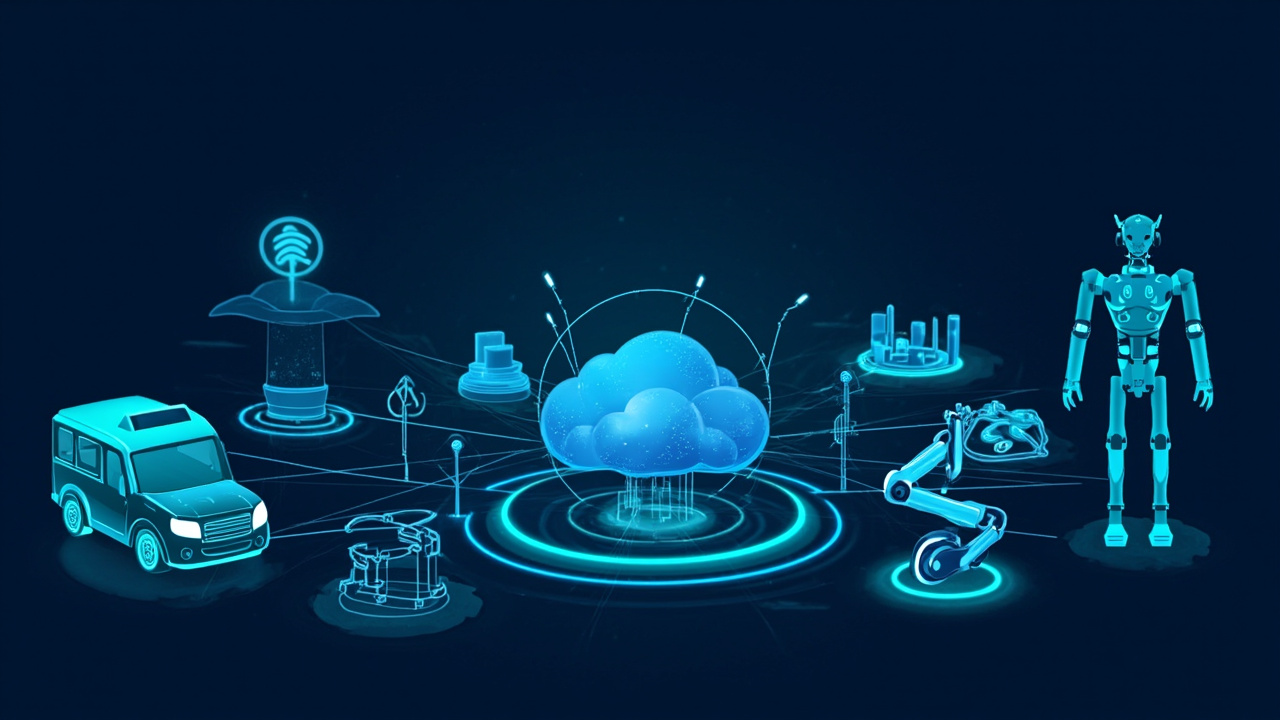
Edge AI is fundamentally transforming how AI inference is deployed, pushing models from the cloud to the network edge to enable real-time, low-latency, and privacy-preserving intelligent applications.
Edge AI: Bringing Intelligence to the Real World
On a clear morning in 2026, an autonomous cargo truck drives along a remote highway on the Qinghai-Tibet Plateau, beyond the reach of any cellular network. Its onboard AI system is identifying road conditions, pedestrians, and obstacles in real time—making decisions about braking or steering—all without a connection to the cloud. This is not a science fiction scenario. It is the reality that Edge AI is enabling today.
When AI inference migrates from the cloud to the network edge, the geographic distribution of computation changes fundamentally. Data no longer needs to travel hundreds of kilometers round-trip to a data center. Instead, it is processed in place, at the node closest to where it was generated. This shift addresses the most fundamental bottlenecks of cloud AI: latency, bandwidth, privacy, and availability.
Why the Edge Matters
The logic of traditional cloud AI architecture is straightforward: upload data to powerful cloud servers, run inference, and return results to the device. This model drove AI adoption over the past decade, but in certain scenarios it is now running into physical and commercial limits.
Latency is the primary bottleneck. A round-trip request to the cloud takes 50 to 200 milliseconds even under ideal network conditions. For scenarios demanding instantaneous reactions—high-speed obstacle detection in autonomous driving, anomaly detection in medical devices, real-time control of factory robotic arms—that latency can be catastrophic.
Bandwidth costs are the second bottleneck. By 2026, global daily data generation exceeds 500 zettabytes. Uploading all of this data to the cloud is neither realistic nor affordable. Processing data locally at its source and transmitting only meaningful summaries or anomaly alerts drastically reduces bandwidth consumption.
Privacy and compliance requirements are the third bottleneck. Sensitive data—medical images, financial transactions, personal footage—is simply not permitted to leave local devices in many jurisdictions. Performing AI inference at the edge means data never leaves its point of origin, naturally satisfying the strictest data sovereignty requirements.
Availability is the fourth consideration. AI systems that depend on cloud connectivity are effectively disabled during network outages. Edge nodes can operate independently, ensuring critical systems keep running in harsh conditions.
The Technical Architecture of Edge AI
Implementing Edge AI is not as simple as copying a cloud model to a local device. Every layer—from model design to hardware selection—requires deliberate reconsideration.
Model Compression and Optimization
Models running on edge devices must be smaller and computationally leaner. Key techniques include:
Quantization: Compressing model weights from 32-bit floating-point to 8-bit integers, or even 4-bit or 2-bit representations. Quantized models are 4 to 8 times smaller and run 2 to 4 times faster, with accuracy loss typically under 1%.
Pruning: Removing neural network connections or neurons that contribute least to predictions—effectively slimming down the model. Structured pruning can reduce computational load by over 50% while maintaining complete model structure, making it easier for hardware to accelerate.
Knowledge Distillation: Training a smaller, faster model (Student) from a large, accurate one (Teacher). The Student learns not just correct answers but the Teacher’s output distribution—the relative relationships between classes—so it can approach the large model’s performance with far fewer parameters.
Neural Architecture Search (NAS): Automatically searching for model architectures optimized for specific hardware and latency budgets. Google’s MNASNet and Facebook’s FBNet series are products of this approach.
At SCGA, our AI integration team selects the optimal combination of these techniques based on each deployment’s computational capacity, memory constraints, and latency requirements—delivering tailored models for every edge scenario.
Hardware Acceleration
General-purpose CPUs are rarely the best choice for Edge AI inference. Hardware purpose-built for neural network computation delivers orders-of-magnitude performance improvements:
NPUs (Neural Processing Units): Purpose-built for matrix operations, widely deployed in high-end smartphones and embedded systems. Apple’s A-series and M-series chips, Huawei’s Kirin NPUs, and Qualcomm’s Hexagon NPU all fall into this category.
Edge GPUs: NVIDIA’s Jetson family (such as the Jetson AGX Orin) delivers up to 275 TOPS of AI performance, supporting multi-model parallel inference—popular for autonomous driving and industrial vision.
FPGAs: Field-Programmable Gate Arrays support highly customized inference pipelines, excelling in ultra-low-latency scenarios like telecom networks.
Edge TPUs: Google’s Edge TPU executes 4 TOPS at just 2W of power, designed for IoT and large-scale edge deployments.
Hardware selection requires balancing compute requirements, power budgets, and cost—while also evaluating how well the target model architecture maps to the hardware. At SCGA, we guide clients through this process with expert advice calibrated to each project’s specific constraints.
The Software Stack
The journey from model training to edge deployment requires a complete software toolchain:
Inference engines are central. TensorRT (NVIDIA), ONNX Runtime (cross-platform), TFLite (Google), Core ML (Apple), and OpenVINO (Intel) each have distinct strengths. Choosing the right inference engine can improve model performance by 2 to 10 times.
Containerization (Docker, Kubernetes) simplifies model distribution and version management across devices. Lightweight Kubernetes distributions like K3s and MicroK8s are optimized for resource-constrained edge nodes.
Model serving frameworks such as Seldon Core and BentoML provide standardized interfaces for model deployment, A/B testing, and traffic management—streamlining operations for edge inference services.
Key Edge AI Application Scenarios
Autonomous Vehicles
Autonomous driving is one of the most demanding Edge AI applications. Onboard systems must complete the full pipeline of perception, decision, and control within an extreme time budget—typically under 100 milliseconds. Any reliance on cloud round-trips is simply unacceptable at highway speeds.
Modern autonomous driving systems typically employ a sensor fusion + deep learning architecture: data from multiple cameras, LiDAR, and radar is fused in real time by neural networks, outputting critical perception results such as obstacle detection, lane recognition, and traffic sign identification. These models are extremely large (e.g., PointPillars or CenterPoint for 3D obstacle detection) and must run on high-performance onboard computing platforms.
SCGA has extensive experience in AI integration for autonomous driving perception systems. Our team can help evaluate sensor configuration trade-offs, select appropriate model architectures, and seamlessly integrate perception systems with the vehicle’s CAN bus and safety control systems.
Industrial IoT and Predictive Maintenance
Factory floors are another major battlefield for Edge AI. Traditionally, equipment maintenance relied on either reactive maintenance (repairing after failure) or scheduled maintenance (inspections at fixed intervals). Edge AI is transforming this into predictive maintenance.
By mounting vibration and temperature sensors on critical equipment components—bearings, gearboxes, motors—data feeds into anomaly detection models (such as LSTM-based time-series anomaly detectors or Isolation Forest algorithms) deployed on factory edge servers. The models continuously learn the equipment’s normal operating profile and, upon detecting subtle deviations from normal patterns, can issue alerts days or even weeks before a failure occurs.
The value is substantial. According to McKinsey, effective predictive maintenance reduces maintenance costs by 10% to 40% and cuts unplanned downtime by 30% to 50%.
At SCGA, we partner with manufacturing companies to evaluate existing IoT infrastructure, design data collection strategies, and deploy AI anomaly detection models to factory edge nodes. Our deployments ensure that even when the network goes down, the monitoring system continues operating and issuing local alerts.
Smart Video Analytics
Traditional CCTV systems require humans watching screens—an inefficient approach prone to fatigue-driven misses. Edge AI upgrades every camera into an intelligent terminal capable of real-time scene understanding.
Common applications include: retail foot traffic analysis and heat-mapping to identify customer movement patterns and purchase interests; construction site safety monitoring to detect whether workers are wearing helmets or entering hazardous zones; city traffic management for real-time traffic flow analysis and incident detection such as accidents or illegal parking.
Edge deployment in these systems avoids the bandwidth costs and latency issues of uploading massive video streams to the cloud. Intelligent analytics results—person counts, anomaly event snapshots—can be transmitted to the cloud cost-effectively for long-term trend analysis and reporting.
Medical Devices
Medical scenarios have extremely high requirements for both latency and privacy, where Edge AI finds its natural habitat. Portable ultrasound devices equipped with AI-assisted cardiac function analysis can detect cardiac anomalies in real time inside ambulances; intelligent microscopes in operating theaters can annotate suspicious tissue in real time to assist surgeons’ intraoperative decisions; wearable ECG devices can monitor for arrhythmias 24/7 and immediately alert medical teams when irregularities are detected.
In these scenarios, Edge AI not only improves diagnostic efficiency and quality, but also ensures the most sensitive medical data never leaves the patient’s side—naturally satisfying HIPAA, GDPR, and local medical data regulations.
Challenges and Trade-offs
Edge AI is not a silver bullet. It introduces new engineering challenges.
Model updates and version management is the primary concern. In cloud deployments, model updates can be pushed instantly; but edge devices may be distributed across thousands of locations with wildly varying network conditions. A robust Over-The-Air (OTA) update mechanism is needed to ensure model version consistency while supporting canary releases and emergency rollbacks.
Hardware-software co-design demands excellence. Different edge hardware has different memory bandwidths, compute unit architectures, and power characteristics. The same model can perform dramatically differently—varying by orders of magnitude—on different hardware. This requires close collaboration between software and hardware teams, with deep optimization targeted at the specific deployment platform.
Edge node security is another critical dimension. Edge devices are physically distributed and more exposed to physical tampering. Model theft, result manipulation, and side-channel attacks are real threats requiring targeted defenses. Trusted Execution Environments (TEE), secure boot chains, and model encryption are common protective measures.
Increased system complexity is a fact of life. Cloud systems have centralized monitoring and log collection. Edge systems are highly distributed. A robust Edge AI deployment requires distributed monitoring platforms, automated operational tools, and anomaly detection mechanisms to ensure thousands of edge nodes remain healthy.
Federated Learning: The Perfect Pairing with Edge
In scenarios involving multiple data sources, the traditional approach of centralizing data in the cloud for training faces enormous privacy and compliance barriers. Federated Learning offers a revolutionary alternative.
The core idea of Federated Learning is elegantly simple: bring the model to the data, not the data to the model. In each training round, the cloud server distributes the current model to edge nodes; each node fine-tunes the model using local data, then uploads only model updates (gradients or weight changes)—not raw data—back to the cloud. The cloud server aggregates updates from all nodes, produces a new global model, and redistributes it to each node.
This process repeats for multiple rounds until the model converges. Each node’s raw sensitive data never leaves the local device. This paradigm has enormous potential in healthcare (hospitals collaboratively training disease prediction models without sharing patient data), finance (banks collaborating on anti-fraud models without sharing customer data), and mobile devices (keyboards learning from millions of users’ typing habits).
Google applied Federated Learning to Gboard’s next-word prediction model; Apple applied it to improve Siri’s speech recognition quality. These cases demonstrate Federated Learning’s viability in large-scale real-world deployments.
Cloud-Edge-Device Integrated Architecture
In SCGA’s project experience, the most successful Edge AI deployments do not treat cloud and edge as opposing choices. Instead, they dynamically allocate compute based on task characteristics—a paradigm we call Cloud-Edge-Device Integrated Architecture.
Real-time perception tasks (obstacle detection, anomaly detection, voice wake-word recognition) execute at the edge, with lowest latency and no network dependency. Complex analysis tasks (long-term trend analysis, batch model updates, cross-node data aggregation) execute in the cloud, leveraging massive compute resources. Tasks between these extremes (local model fine-tuning, data summarization, multi-node collaborative inference) run on regional edge servers—intermediate nodes near the data source—balancing latency and computational depth.
A well-designed Cloud-Edge-Device architecture requires clear definitions of responsibilities, data flows, and failover strategies at every layer from the very start of system design. This is precisely where SCGA’s AI integration team delivers core value from the earliest project phases.
Edge AI and SCGA
At SCGA, we have helped multiple enterprises move AI from the cloud to the edge—from proof of concept to large-scale production deployment. From factory floor anomaly detection systems, to autonomous vehicle fleet perception platforms, to smart video surveillance in remote areas, our AI integration team has hands-on delivery experience.
Our approach:
We start with the problem, not the technology. Edge AI is not a universal solution. We first assess your real requirements—latency targets, network conditions, data sensitivity, device resources—and determine whether edge deployment is the optimal choice and how to architect it accordingly.
We deliver end-to-end, without gaps. We cover the complete pipeline from model evaluation and compression, hardware selection and procurement guidance, software stack deployment, through to system testing and production monitoring—without relying on multiple vendors delivering in fragmented segments.
We build for operability and continuous evolution. Our deployments include model update and monitoring mechanisms, ensuring systems continuously benefit from performance improvements driven by new data, while remaining manageable by your operations team.
Looking Ahead: The Next Steps in Edge AI
Edge AI continues to accelerate in 2026. Several directions deserve attention:
More powerful edge silicon. NVIDIA’s next-generation Jetson platform will deliver near-data-center AI performance at under 15W. Qualcomm’s and MediaTek’s latest mobile chips double NPU performance every year. What requires cloud-scale compute today will run at the edge tomorrow.
6G and the compute fabric. While 5G has already dramatically improved edge device connectivity, 6G standards are being drafted with higher peak rates and lower latency. In the 6G era, the boundaries between cloud, edge, and device will become more dynamic—compute resources routable on demand like electricity or water.
Edge AI-native frameworks. More frameworks are building native Edge AI support—from EdgeML, which considers deployment constraints during training, to Ray, which natively supports distributed inference. Maturing development tools will lower the engineering barrier to Edge AI.
The rise of autonomous systems. From self-driving vehicles and drones to smart factories, Edge AI is the technological foundation for all autonomous systems. As these systems become more prevalent, the importance of Edge AI will only grow.
Conclusion
Edge AI is not a replacement for cloud AI—it is a necessary complement. When AI’s application scenarios expand from data centers to factory floors, farmlands, ambulances, city corners, and remote mines, computation must follow data to where it needs to be.
At SCGA, we believe Edge AI is a core engine for the next wave of AI value creation. Our team combines deep experience in both cloud AI and edge deployment to help you evaluate, design, and deliver intelligent systems that truly work in the real world.
Does your AI application have a scenario that cannot do without the edge? Let’s talk about how SCGA can help bring intelligence to where it needs to be.
SCGA provides Edge AI integration, machine learning model deployment optimization, and Industrial IoT application development. Contact us to learn how we can support your edge intelligence projects.