Time Series Forecasting: Predict Future Trends with AI - Complete Guide
S.C.G.A. Team
March 14, 2026
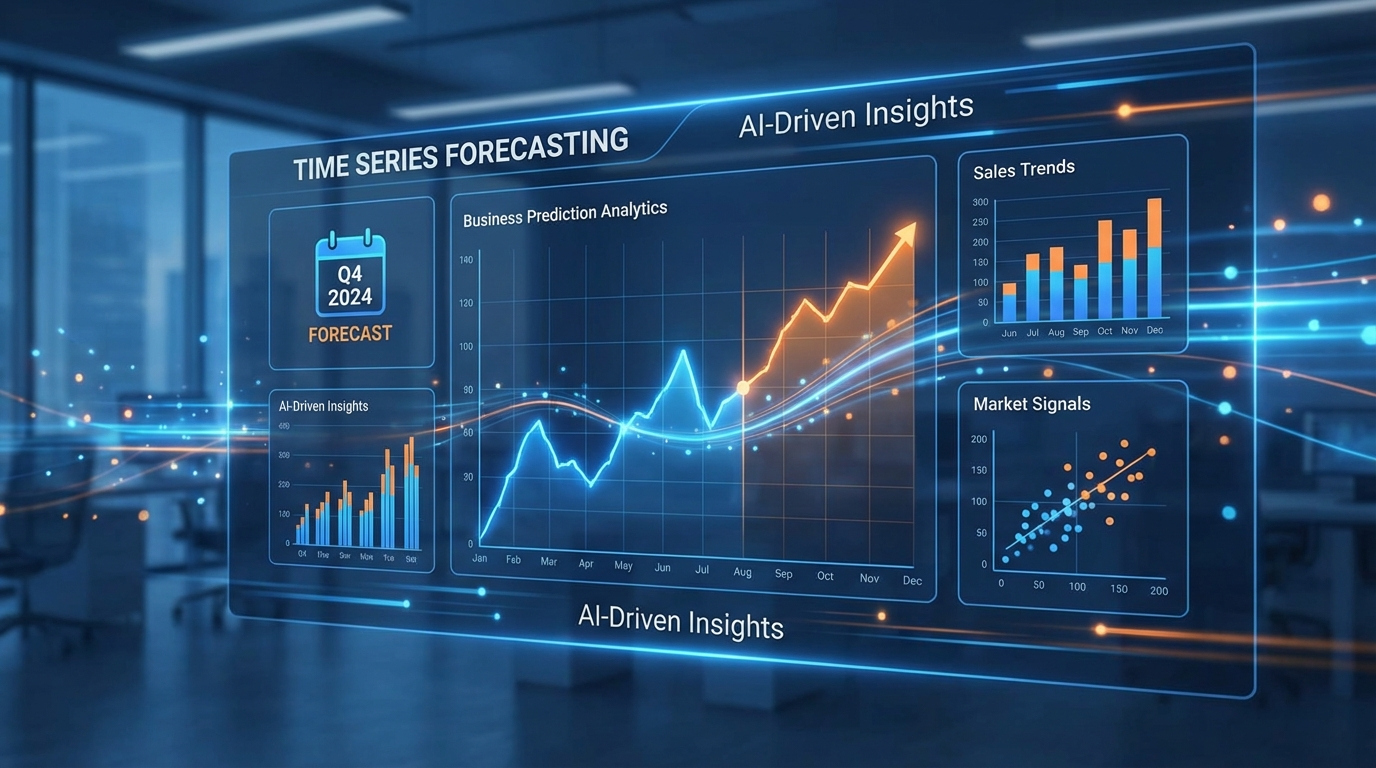
Time series forecasting helps businesses predict future trends accurately using advanced AI techniques.
Time series forecasting is one of the most powerful applications of machine learning, enabling businesses to predict future trends, demand, and patterns with unprecedented accuracy. From retail inventory planning to financial market analysis, time series forecasting provides critical insights that drive better business decisions.
Every business generates time series data—sales records, website traffic, customer arrivals, stock levels. This data contains valuable patterns that, when properly analyzed, can predict future values. Modern AI techniques make these predictions more accurate than ever before.
What is Time Series Forecasting?
Time series forecasting uses historical data to predict future values. Unlike traditional prediction problems, time series data has a temporal component where the order of data points matters significantly.
Time series analysis involves identifying patterns like trends, seasonality, and cycles in historical data, then using these patterns to project future values. Modern approaches combine statistical methods with machine learning to achieve superior accuracy.
Key Concepts in Time Series
Trend
The long-term direction of the data. Identifying trends helps understand where the series is heading over time.
Seasonality
Regular patterns that repeat over fixed periods. Seasonality is crucial for retail, where sales spike during holidays.
Cycles
Longer-term patterns that aren’t strictly periodic. Economic cycles are a common example.
Noise
Random variation that cannot be explained by patterns. Noise makes prediction challenging but must be accounted for.
Autocorrelation
The relationship between values at different time points. Understanding autocorrelation is key to building accurate models.
Applications of Time Series Forecasting
Sales Forecasting
Predict future sales to optimize inventory, staffing, and financial planning. Accurate sales forecasts reduce waste and improve customer satisfaction.
Demand Planning
Forecast product demand to optimize supply chain operations. This reduces both stockouts and excess inventory.
Inventory Management
Predict inventory needs to maintain optimal stock levels. This balances carrying costs with availability.
Financial Planning
Forecast revenue, expenses, and cash flow for budgeting and strategic planning. Accurate financial forecasts enable better resource allocation.
Web Traffic Prediction
Predict website visits to plan infrastructure and marketing campaigns. This ensures optimal user experience during peak periods.
Energy Load Forecasting
Predict energy demand to optimize generation and distribution. This is critical for utility companies and large facilities.
Weather Prediction
While not directly related to business, weather forecasts affect many business decisions from retail to logistics.
Stock Price Prediction
Predict financial instrument prices for investment decisions. While challenging, time series models provide valuable insights.
Techniques We Use
Classical Statistical Methods
- ARIMA: Autoregressive Integrated Moving Average - foundational time series method
- SARIMA: Seasonal ARIMA - handles seasonal patterns
- Exponential Smoothing: Simple but effective for certain patterns
- VAR: Vector Autoregression - for multiple related series
Machine Learning Methods
- XGBoost: Gradient boosting for tabular time series
- Random Forests: Ensemble method for robust predictions
- Support Vector Regression: Kernel-based method for complex patterns
Deep Learning Methods
- LSTM: Long Short-Term Memory networks - excellent for long sequences
- GRU: Gated Recurrent Units - efficient alternative to LSTM
- Transformer: State-of-the-art for sequence modeling
- CNN-LSTM: Convolutional layers for feature extraction
Specialized Libraries
- Prophet (Facebook): Easy-to-use forecasting for business applications
- NeuralProphet: Neural network version of Prophet
- StatsForecast: Fast statistical forecasting
Our Approach to Time Series Projects
1. Data Exploration
We analyze your historical data to understand patterns, identify anomalies, and assess data quality. This shapes our modeling approach.
2. Feature Engineering
We create relevant features from the time series including lagged values, rolling statistics, and calendar features. Good features are crucial for accuracy.
3. Model Selection
We test multiple approaches to find the best method for your specific data. Sometimes simple methods outperform complex ones.
4. Training and Validation
We train models using historical data and validate using held-out periods. We use proper time series cross-validation to avoid data leakage.
5. Deployment
We deploy models to production with automated pipelines for ongoing predictions. We set up monitoring to track accuracy over time.
6. Maintenance
We retrain models as new data becomes available and monitor for concept drift. Ongoing maintenance ensures predictions remain accurate.
Benefits of AI-Powered Forecasting
BenefitTraditional MethodsAI-Powered Accuracy60-70%85-95% Handling ComplexityLimitedExcellent AutomationManualFully automated Multiple FactorsDifficultSimultaneous AdaptabilitySlowContinuous learning
Industries We Serve
- Retail: Sales forecasting, inventory optimization
- Manufacturing: Demand forecasting, production planning
- Energy: Load forecasting, renewable prediction
- Finance: Stock prediction, risk forecasting
- Healthcare: Patient volume, equipment usage
- Logistics: Shipment forecasting, route planning
Success Stories
Retail Chain
Implemented demand forecasting that reduced inventory waste by 35% and improved product availability by 40%.
Manufacturing Company
Built production forecasting that optimized manufacturing schedules and reduced costs by 20%.
Energy Company
Developed load forecasting that improved grid management and reduced peak-time shortages by 25%.
Advanced Time Series Techniques
Multivariate Time Series
Beyond single-series forecasting, multivariate models can incorporate multiple related series simultaneously. This captures interdependencies between variables—how changes in one series affect others.
Hierarchical Time Series
Hierarchical forecasting handles data with nested structures—product categories, geographic regions, or organizational units. It ensures predictions are coherent across all levels of the hierarchy.
Probabilistic Forecasting
Beyond point predictions, probabilistic forecasting provides prediction intervals and probability distributions. This quantifies uncertainty and enables risk-aware decision making.
Deep Learning for Time Series
Advanced deep learning architectures have shown remarkable success. Transformer Models, Temporal Convolutional Networks, Attention Mechanisms, and Autoencoders all contribute to more accurate forecasting and anomaly detection.
Data Requirements for Time Series Forecasting
Time series forecasting requires data with specific characteristics. Understanding these requirements helps ensure your forecasting project starts on solid ground.
Sufficient Historical Data
Forecasting models need adequate historical data to identify patterns reliably. The minimum data requirements depend on the frequency of observations and the complexity of patterns. Daily data typically requires 2-3 years minimum, while hourly data might need months. More data generally improves accuracy, especially for capturing long-term trends and seasonal patterns.
Data Quality and Completeness
Missing data and anomalies degrade forecasting accuracy. Develop processes for handling missing values, identifying outliers, and correcting data errors before forecasting. Interpolation, imputation, and robust statistical methods help manage imperfect data without significantly compromising accuracy.
Stationarity and Transformations
Many forecasting methods assume stationarity—statistical properties that remain constant over time. Non-stationary data with trends or changing variance requires transformation through differencing, detrending, or variance-stabilizing transformations. Understanding your data’s stationarity properties guides method selection.
Evaluating Forecast Accuracy
Measuring forecast accuracy requires appropriate metrics and validation approaches. The right evaluation methodology depends on your forecasting horizon and business context.
Forecast Error Metrics
Common metrics include Mean Absolute Error (MAE), Mean Squared Error (MSE), and Mean Absolute Percentage Error (MAPE). Each metric has strengths and limitations. MAPE works well for business metrics but can be infinite for values near zero. MAE is interpretable but penalizes all errors equally. MSE emphasizes large errors more heavily.
Holdout Validation
Reserve recent data as a holdout set to evaluate forecast accuracy on truly future predictions. This simulates real-world forecasting conditions and provides an unbiased estimate of how your model will perform going forward. Time series cross-validation extends this approach across multiple holdout periods.
Baseline Methods
Always compare your sophisticated models against simple baselines: persistence (tomorrow equals today), seasonal naive (tomorrow equals today last week), or moving averages. If your complex model barely beats a naive approach, the added complexity may not be justified.
Advanced Forecasting Topics
Beyond standard forecasting approaches, advanced topics expand what’s possible with time series analysis. These sophisticated techniques address complex forecasting scenarios that basic methods cannot adequately handle.
Global Forecasting Models
Global forecasting models train single models across multiple related time series rather than separate models for each series. This approach leverages information from related series to improve individual series predictions. Retail chains forecasting product demand across many stores benefit from global models that share patterns across locations.
Neural Hierarchical Time Series
Hierarchical time series exist at multiple aggregation levels—individual products roll up to categories, which roll up to divisions. Neural hierarchical models produce coherent predictions at all levels simultaneously, ensuring that bottom-level predictions sum correctly to top-level forecasts.
Counterfactual Forecasting
Counterfactual forecasting estimates what would have happened under different conditions. How would demand have differed without the promotional campaign? What would sales have been without the competitor’s entry? These causal questions require specialized techniques beyond standard prediction.
Forecasting Implementation Best Practices
Successfully implementing time series forecasting requires more than selecting the right algorithms. Organizations that achieve genuine business value from forecasting invest in the people, processes, and infrastructure that support forecasting over the long term.
Building a Forecasting-Focused Culture
Forecasting success requires organizational commitment beyond technical implementation. Business users must trust forecast outputs enough to act on them, which requires transparency about how forecasts are generated and regular communication about forecast accuracy. When forecasts prove inaccurate, root cause analysis should determine whether the issue was model-related, data-related, or resulted from genuine structural change.
Training programs build forecasting literacy across the organization. Business users who understand forecasting fundamentals can interpret forecasts appropriately and identify when unusual circumstances might warrant deviation from standard predictions. This distributed understanding multiplies the value of specialized forecasting expertise.
Governance and Process Design
Effective forecasting requires governance structures that define roles, responsibilities, and decision rights. Who has authority to override forecasts? When should forecast-driven decisions be escalated? What processes govern forecast model updates? Clear governance prevents confusion and ensures accountability.
Process integration embeds forecasting into operational workflows. Forecasts should automatically reach the systems and people who use them, without requiring manual retrieval or distribution. This integration requires upfront API development but pays ongoing dividends through reduced manual effort and improved timeliness.
Managing Forecast Uncertainty
All forecasts carry uncertainty, and effective use of forecasts requires understanding and communicating that uncertainty appropriately. Prediction intervals provide explicit uncertainty estimates, revealing the range of likely outcomes rather than single point predictions. Communicating uncertainty to business stakeholders prevents overreliance on precise-looking forecasts.
Scenario planning extends point forecasts into ranges of outcomes. Best case, expected case, and worst case scenarios help stakeholders plan for uncertainty without requiring them to interpret statistical prediction intervals. This approach is particularly valuable when communicating with non-technical stakeholders.
Building Forecasting Capability
Organizations that achieve sustained value from forecasting invest in building comprehensive capabilities, not just implementing technology. This requires attention to people, processes, and data infrastructure.
Cross-Functional Collaboration
Effective forecasting requires collaboration between data scientists, domain experts, and business stakeholders. Data scientists bring technical expertise in model development. Domain experts provide contextual knowledge about business factors that affect forecasts. Business stakeholders ensure forecasts align with operational requirements and strategic objectives.
Data Quality and Governance
Forecasting accuracy depends fundamentally on data quality. Organizations should establish data governance practices that ensure forecast-relevant data is accurate, complete, and consistently formatted. This includes data validation, anomaly detection, and processes for addressing data quality issues.
Integration with Business Processes
Forecasts create value only when integrated into business workflows. Organizations should map how forecasts inform decisions, what systems receive forecast outputs, and how forecast-driven actions are tracked. This integration requires upfront development but pays ongoing dividends through improved decision-making.
The Future of Time Series Forecasting
The future of forecasting involves increasingly sophisticated techniques and broader applications. Foundation models pre-trained on massive datasets will reduce the data requirements for new forecasting applications. Automated ML will accelerate model development, enabling more organizations to benefit from forecasting capabilities.
Real-Time Forecasting
Traditional forecasting often operates in batch modes with periodic updates. The trend toward real-time forecasting enables continuous prediction updates as new data arrives. This capability is particularly valuable for applications where conditions change rapidly and forecast accuracy degrades quickly.
Explainable Forecasting
As forecasting influences more consequential decisions, explainability becomes increasingly important. Stakeholders want to understand not just what the forecast predicts but why. Explainable forecasting techniques reveal the factors driving predictions, building trust and enabling appropriate use.
Conclusion
Time series forecasting can transform your business planning and decision-making. Accurate predictions enable better resource allocation, reduced costs, and improved customer satisfaction.
At S.C.G.A., we specialize in building accurate time series forecasting systems tailored to your business needs. Contact us today to discover how forecasting can transform your operations.